
Where can I buy or rent high-quality red carpets for events?
Quick Answer: High-quality red carpets for events are available through professional event production companies, specialty décor rental houses, and commercial flooring suppliers. For most events, renting delivers fresher inventory, professional installation, and lower total cost than purchasing. Always verify pile height, width options, and edge finishing before committing to any vendor.
Why the Red Carpet Decision Matters More Than You Think
The red carpet is not a detail — it is a first impression made permanent by every photo taken at your event. Before a single guest shakes a hand, signs a program, or hears a welcome speech, they have already formed an opinion based on what they walked in on. A crisp, well-installed red carpet communicates professionalism, care, and production value. A wrinkled, narrow, or faded one communicates the opposite — and that perception follows your event into every photograph and social post that comes out of it.
This guide covers every sourcing option available, breaks down the honest comparison between buying and renting, details the product specifications that actually matter, and identifies the mistakes most people make so yours never has to be an example.
What Type of Event Are You Planning?
The right red carpet solution is different depending on the type of event you are running. Before you call a single vendor, know which category you are working in — it changes your width requirements, pile specification, and vendor tier immediately.
- Corporate galas and award ceremonies: Entry corridors need width. Standard 4-foot runners are not appropriate here. When guests are walking through alongside stanchion lines and photographers are positioned to capture arrivals, you need a minimum of 8 feet — often more. The carpet is also holding brand weight: it is in every arrival photo that gets shared internally and externally.
- Film, entertainment, and brand premieres: The highest-scrutiny deployment. Close-range photography means every flaw in pile density, color consistency, and edge condition is captured and published. There is no margin for compromise on product quality at this tier.
- Fundraisers and charity galas: Donors arrive with a giving mindset that can be amplified or deflated by the entry experience. A well-executed red carpet arrival primes attendees for generosity before they sit down. A cheap one signals that the organization cuts corners — not the message any fundraiser wants to send.
- Weddings and social celebrations: Here the carpet most often functions as a ceremony aisle runner, venue entry feature, or photo activation element. Color accuracy under ambient and candlelight is critical. Softness underfoot matters. And the carpet must photograph cleanly at the close range of wedding photography.
- Product launches and brand activations: These events integrate the carpet directly into the brand environment. Color matching to brand standards, integration with step-and-repeat backdrops, and coordination with branded stanchion ropes are all requirements, not preferences.
- Private parties and milestone celebrations: Red carpet rentals for private events are more common than most people expect. A 50th birthday, a graduation party, or a holiday gala all benefit from a professional-grade entry experience. For these events, quality still matters — a worn-out rental carpet communicates as clearly as a premium one.
Buying vs. Renting a Red Carpet: The Honest Comparison
This question comes up for anyone planning more than one red carpet event per year, and the answer is almost always the same once the full picture is on the table.
The Case for Renting
Renting is the right choice for the majority of event hosts and planners. Here is why the economics favor it in most scenarios:
- Professional rental vendors maintain and replace their inventory regularly. You receive a carpet that looks new because it functionally is — rotated, reconditioned, or replaced between events.
- Delivery, installation, and strike are included in the rental. The labor cost of transporting, laying, and removing carpet on your own is not trivial, especially at events where load-in windows are tight.
- You access premium product tiers — velvet pile, wide-format seamless options, specialty colors — without carrying those costs between events.
- There is no storage requirement, no cleaning liability, and no depreciation to track. When the event is over, the carpet leaves with the vendor.
For anyone producing fewer than 8 to 10 red carpet events per year, renting is almost always more cost-effective when the full calculation includes storage, maintenance, transportation, and replacement cycles.
The Case for Buying
Purchasing makes sense in a narrow set of circumstances. It is worth evaluating only if you meet all of the following criteria:
- You produce 10 or more red carpet events annually on a predictable schedule
- You have dedicated, climate-controlled storage with sufficient square footage to roll and store carpet without creasing
- You have trained staff available for transport, installation, and proper reconditioning between uses
- You have budgeted for replacement every 2 to 3 years as pile compresses and color fades
If any of those conditions are not met, the apparent savings of ownership disappear quickly. Contract-grade event carpet in a mid-range nylon or polypropylene product runs $3 to $6 per linear foot before shipping. A 50-foot run at 6-foot width costs $900 to $1,800 at purchase — and that number climbs significantly when you add storage infrastructure, maintenance, and replacement cycles to the ledger.
Where to Source High-Quality Red Carpets
Every sourcing channel has a legitimate use case. The key is matching the source to what your event actually requires.
Professional Event Production Companies
This is the highest-quality sourcing channel for events where the carpet will be photographed, branded, or experienced by a large number of guests. Full-service event production companies do not just deliver a carpet — they assess your venue, specify the right product for your floor surface and event type, execute a professional installation, and are accountable for the result in a way no retailer can match.
The Phoenix DG provides professional red carpet services as part of a full event production offering. Rather than sourcing carpet as a standalone rental, their team integrates the carpet specification into the broader entry experience — coordinating with lighting, stanchion placement, and backdrop positioning so every element works together as a system. For events where the entry experience is a production moment, that level of integration makes a measurable difference in how the event photographs and how guests experience arrival.
Learn more about what a professionally produced entry experience looks like by visiting The Phoenix DG’s event production services.
Specialty Décor and Linen Rental Houses
Many markets have event rental companies that carry carpet alongside linens, furniture, lounge seating, and lighting. These vendors can be good mid-tier options for events that need a quality product without full production support. The variation in inventory quality is significant, however. Ask specifically about pile height, fiber type, and edge finishing before assuming the product will perform at your event’s level.
Party Supply and General Event Rental Chains
Budget event rental chains typically carry thin synthetic runners intended for low-traffic decorative use. These products are appropriate for low-visibility applications where aesthetics are not a primary concern. They are not appropriate for events with photographer presence, large guest counts, or any situation where the carpet will appear prominently in event photography.
Commercial Flooring Suppliers
For organizations that have determined purchasing is the right long-term decision, commercial flooring suppliers offer the widest selection of contract-grade product. Look specifically in the hospitality and convention center category. These products are engineered for repeated installation cycles and heavy foot traffic in ways that residential carpet is not. Do not use residential carpet for event applications — the pile density, backing construction, and durability are all wrong for the use case.
Online Wholesale Marketplaces
International wholesale platforms carry event carpet at very low per-unit cost. The tradeoffs are real: color accuracy on a screen is unreliable, shipping windows are unpredictable, and quality control is entirely your responsibility. If this route makes sense for your budget, always order a physical sample before committing to volume, and build in a minimum 6 to 8 weeks of delivery buffer before your event date.
Product Specifications That Actually Matter
Most people shopping for event carpet for the first time do not know which specifications to ask about. These are the ones that determine whether the carpet performs at your event.
- Pile height: The professional standard for photographed events is 1/2 inch to 3/4 inch. Below that threshold, the carpet looks flat and thin on camera regardless of color. Plush and velvet pile products exceed 3/4 inch and offer the highest visual impact, but require more precise installation to prevent edge lifting under foot traffic.
- Pile fiber: Nylon resists crushing under heavy traffic and holds color longer than alternatives. Polypropylene is less expensive but shows footprints more readily and fades faster with exposure to light. Velour and velvet products offer luxury appearance but require careful handling and reconditioning.
- Backing construction: Rubber-backed carpet is non-slip and stable without requiring tape on most surfaces — critical for guest safety in formal footwear. Fabric or jute backing requires double-sided tape on every installation, which adds labor time and complicates removal on finished floors.
- Width: Standard event carpet is available in 4-foot, 6-foot, and 8-foot widths. For anything wider, confirm whether the vendor offers seamless product or seamed panels. Visible seams in a high-photography entry zone are not acceptable.
- Color accuracy: Red is not one color. Burgundy, crimson, scarlet, and cherry all appear under the “red carpet” label depending on the vendor. Always request a physical swatch and review it under the lighting conditions of your venue — not on a monitor.
Common Mistakes and What They Cost You
These errors show up consistently in post-event reviews, and every one of them is avoidable with the right sourcing decision made early enough.
Ordering the Wrong Width
A carpet that forces guests to walk single-file is not a red carpet experience — it is a hallway runner. For any event with a step-and-repeat backdrop and photographer positioning, the carpet must be wide enough for two to three guests to stand side by side naturally. Measure your entry zone, confirm the width requirement in writing with your vendor, and do not assume a standard width is appropriate without verifying it against your specific setup.
Accepting Worn Inventory
Vendors who do not rotate or recondition their inventory between rentals deliver carpets with flattened pile, visible footprint patterns, and inconsistent color across the surface. These defects cannot be fixed on-site. The only protection is asking vendors directly about their inventory replacement schedule and their reconditioning process — and choosing a vendor whose answer is specific rather than vague.
Skipping the Venue Assessment
Carpet installed on an uneven floor without foam padding creates trip hazards and surface rippling that is visible in photos. Transitions between carpet and hard flooring at doorways require edge finishing that must be specified in advance, not improvised during installation. Any vendor who quotes without asking about your floor surface has not thought through your installation.
Booking Too Late
Quality red carpet inventory is finite, and peak event seasons concentrate demand into narrow windows. Planners who approach vendors three weeks before a major event frequently find that the premium options — wide-format seamless product, high-pile velvet, specialty colors — are already committed. Book your carpet vendor when you book your venue, not as a follow-up task.
Isolating the Carpet from the Rest of the Entry Design
A well-specified carpet surrounded by mismatched stanchions, wrong-height ropes, and absent lighting still produces a weak entry experience. The carpet, the lighting that illuminates it, the stanchion system that frames it, and the backdrop that anchors it must be designed and installed as a coordinated system. Vendors who source only the carpet without considering these integrations are leaving the most important work undone.
For entry experiences designed as a complete system, The Phoenix DG integrates every element of the arrival zone under a single production framework.
Why Choose The Phoenix DG
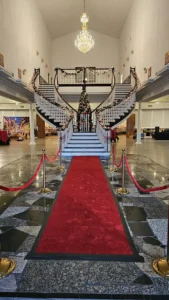 For anyone who needs more than a carpet delivery — who needs the entry experience to actually perform — The Phoenix DG offers a production-grade alternative to commodity rental.
- Experience across event categories: The Phoenix DG has executed red carpet experiences for corporate, entertainment, nonprofit, and social events. That breadth means they understand how the requirements differ between a brand activation and a charity gala — and they specify accordingly, rather than applying the same solution to every brief.
- Reliability at the production level: Red carpet events run on hard timelines. The Phoenix DG operates with logistics protocols that ensure the carpet is installed, inspected, and ready before the first guest arrives — not during load-in, not while the venue is filling up.
- Integrated quality: Rather than sourcing carpet in isolation, The Phoenix DG pairs carpet specification with compatible lighting, stanchion systems, and backdrop coordination. The result is an entry zone that looks intentional in every photo — because it was designed that way from the start.
- Service area: The Phoenix DG serves events across the region at major hotel ballrooms, convention venues, outdoor activations, and private estates. Confirm your specific location and event date directly with their team.
Explore the full range of what The Phoenix DG produces for special events and corporate productions.
Questions to Ask Every Vendor Before You Book
Use these during any vendor qualification call. The quality of the answers will tell you what you need to know about whether that vendor can actually deliver.
- What is the pile height and fiber composition of the carpet in your inventory?
- How often is your carpet inventory replaced, and what is your reconditioning process between events?
- Do you offer seamless widths above 8 feet, or do wider installations require seamed panels?
- What is your installation process on uneven surfaces, and do you use foam padding as standard?
- Do you carry matching accessories — stanchions, rope color, edge finishing — that integrate with the carpet?
- What is your day-of protocol if the carpet arrives damaged or does not match the specification ordered?
A vendor who answers every question with specificity and confidence is one worth booking. A vendor who hedges, defers, or says “we’ll sort it out on the day” is a risk your event cannot afford.
To discuss your event’s specific red carpet requirements with a team that has answered all of these questions across hundreds of productions, visit thephoenixdg.com/.
Coordinating the Full Entry Zone
The carpet is the foundation — not the whole picture. Every element surrounding it must be specified and coordinated in advance for the entry experience to read as a professional production.
- Lighting: Directional lighting aimed at the carpet surface brings out pile texture and saturates color in ways that ambient venue lighting cannot achieve. Pin spots or wash lights positioned at the correct angle are the single biggest differentiator between a carpet that photographs at event-grade and one that looks flat in images.
- Stanchion system: Stanchion height, base weight, post finish, and rope color must all be specified relative to carpet width and venue ceiling height. A low stanchion system on a wide carpet looks proportionally wrong and photographs poorly.
- Step-and-repeat backdrop: The carpet must terminate flush with the backdrop base. Any gap between carpet edge and backdrop creates a visible floor break in every photograph shot at that angle. This requires active coordination between carpet installer and backdrop vendor on the installation day.
- Photographer positioning: A properly designed entry zone includes a designated photography buffer — typically 8 to 12 feet of open space at a 45-degree angle from the backdrop — so photographers can capture arrival shots without crowding the carpet surface.
When The Phoenix DG manages a full entry experience, these elements are not sourced independently and coordinated at the last minute — they are designed together from the initial brief. That integration is what produces an arrival zone that looks like a production rather than an assembly of parts. See how that comes together at thephoenixdg.com/.
Frequently Asked Questions
How far in advance do I need to book a red carpet rental?
For events with more than 200 guests or any event falling within peak season — October through December and April through June — book your carpet vendor a minimum of 6 to 8 weeks out. Wide-format, high-pile, and specialty color inventory books out earliest. If your event requires seamless widths above 8 feet or custom color matching, 10 to 12 weeks is a safer lead time. Always confirm with a signed agreement and deposit, not a verbal hold.
What is the difference between a carpet runner and an event-grade red carpet?
A carpet runner is typically 2 to 4 feet wide, uses a basic pile weight, and is designed for corridor decoration or low-traffic aisle use. An event-grade red carpet is 6 to 10 feet wide, constructed with heavier pile, and finished with bound or serged edges that withstand heavy foot traffic and repeated installation cycles. For any event where the carpet will be photographed up close or traversed by large numbers of guests, a runner is not the appropriate product.
Can red carpet be installed outdoors, and are there special requirements?
Yes, with the right product specification. Standard indoor event carpet is not UV-stabilized and will fade in direct sunlight. For outdoor installations, specify solution-dyed nylon or polypropylene fiber, which holds color better under UV exposure. The backing must be rubber or a weather-resistant alternative — jute backing absorbs moisture and can degrade quickly in humid outdoor conditions. Edge securing outdoors typically requires staking or weighted strip systems rather than adhesive tape, which does not bond reliably on concrete or pavers in warm weather.
What should I do if the carpet arrives damaged or the wrong color on event day?
Before signing any rental agreement, confirm the vendor’s damage replacement policy and their day-of response protocol explicitly in writing. A professional vendor has a backup inventory protocol and a response team. On the day of installation, conduct a visual inspection of the carpet before guests arrive — not after load-in is complete and the venue is open. Any defect identified before the event gives you time to seek a remedy. A defect identified during the event gives you nothing.
Is custom color or branded red carpet available, and what does it require?
Custom color carpet is available through select vendors and commercial flooring suppliers, but requires production lead time of 4 to 8 weeks minimum. Custom-printed carpet with integrated logos or brand graphics is a separate product category with higher price points and longer timelines. For most events, the more cost-effective branding approach is to invest in the step-and-repeat backdrop, branded stanchion ropes, and targeted lighting rather than custom carpet fabrication. Discuss your branding requirements early enough that all options can be properly evaluated against your budget and timeline.